

Assembly Compare 3D
Assembly Compare 3D is an easy-to-use application for the quality control of semi-finished or fully assembled products. Setting up this solution—which is suitable for both assembly verification and dimensional inspection—is extremely simple; it requires only a reference product, a "golden sample," or a CAD model. The software supports a wide range of 3D scanners. The choice of camera depends on the specific application, product size, and required level of accuracy. Depending on the camera used, the scanning range extends from 20 cm up to 750 cm, allowing for the inspection of both small and large products.
Assembly Compare 3D - Features
Assembly Compare 3D is an easy-to-use application for the quality control of semi-finished or fully assembled products. Setting up this solution—which is suitable for both assembly verification and dimensional inspection—is extremely simple; it requires only a reference product, a "golden sample," or a CAD model. The software supports a wide range of 3D scanners. The choice of camera depends on the specific application, product size, and required level of accuracy. Depending on the camera used, the scanning range extends from 20 cm up to 750 cm, allowing for the inspection of both small and large products.
The software also supports multiple measurements of the product from different viewpoints. It handles rotation or displacement of the camera or the product without issue. This makes Assembly Compare 3D ideal for robotic applications, where product repositioning and quality inspection can be performed in a single step. It performs well under varying lighting conditions and—with the right scanner—can even be used outdoors. Running on a standard computer, the 3D scanning and inspection process takes 2–5 seconds (Ensenso) or 0.5–1 second (NION). Processing time is reduced when using a computer equipped with a more powerful GPU.
- Easily usable/ Zero programming
- Reliable operation even in varying lighting conditions
- Fast and reliable quality control
- Supports robot applications
- Precise: point resolution up to 0.2 mm and detection accuracy of 0.5 mm
- Scanning range: 20 cm – 750 cm

CAD model
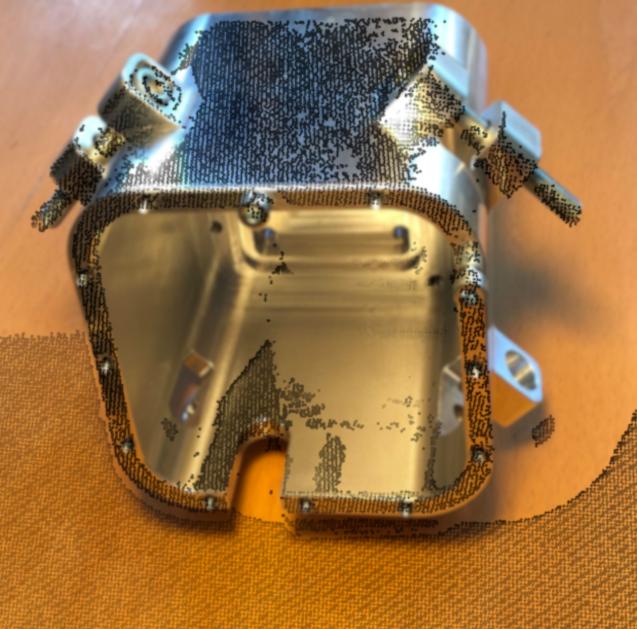
Reference Golden DUT / product
Projects and steps
A Project consists of an ordered sequence of Steps, where each Step is an inspection task—specifically, a reference scan or import along with its associated tests. Marker boxes, cutting planes, and threshold values are stored separately for each Step.
Consequently, a single Project can include multiple views of the same product or even views of entirely different products. During automated execution, only the specific Step required at that moment is performed.
The software supports various camera settings—allowing for a trade-off between faster computation and higher accuracy—enabling the user to select the configuration best suited to the specific application. Configuration adjustments made via the camera's native SDK library take effect immediately within the Assembly Compare 3D software. If the camera does not support this (e.g., Ensenso), the configuration can easily be imported in JSON file format.
File management:
- Box layout (.acbf): contains all marker boxes, cutting planes, and markers, but excludes the reference point cloud.
- Step (.acrf): stores everything included in the box layout, plus the reference point cloud and its associated parameters.
- Project (.acpf): stores all steps plus project-specific data (e.g., project name).
Undo and redo functions track history on a per-Step basis but are not saved to any of the files.
Teach-in process
The user scans or imports a golden sample and then selects the specific regions of the point cloud required for alignment and comparison. Clipping planes can be used to remove large regions of the point cloud that are not part of the inspection, while the exclusion function handles smaller details. Point cloud differences arising from mechanical positioning deviations can be compensated for with the search radius around the Position boxes. The accuracy of the comparative evaluation is limited by the capabilities of the camera, but the user has the option to control the validation threshold, which sets a lower limit for accepting the distance between points paired up after alignment. In addition, a threshold can also be specified as a percentage per Match box, defining what percentage of the points inside it must find a correct pair in order for that box to pass the test.Marking the reference. Key parts of the point cloud during editing can be marked using marker-boxes:
- Positioning boxes (purple) contain environmental features or product components that are consistently present during the scanning of test products and maintain a fixed spatial relationship to the parts being compared. The reference points defined by these boxes used for the alignment of test product point clouds with the reference.
- Matching boxes (green) contain the specific parts of the reference product to be inspected. The reference points defined by these boxes are used in the comparison of the test products.
Box manipulation: The software provides several different methods for performing operations quickly and easily.

Positioning:
- Along the X-axis: with the red arrow | with the F1 key | by entering a specific value
- Along the Y-axis: with the green arrow | with the F2 key | by entering a specific value
- Along the Z-axis: with the blue arrow | with the F3 key | by entering a specific value
Scaling:
- Along the X-axis: with the F4 key | by entering a specific value
- Along the Y-axis: with the F5 key | by entering a specific value
- Along the Z-axis: with the F6 key | by entering a specific value
Rotation:
- Along the X-axis: with the red curved arrow | with the F7 key | by entering a specific value
- Along the Y-axis: with the green curved arrow | with the F8 key | by entering a specific value
- Along the Z-axis: with the blue curved arrow | with the F9 key | by entering a specific value
Hotkeys: Ctrl+A, Ctrl+C, Ctrl+V, Ctrl+Z, Ctrl+Y
Simultaneous editing of multiple boxes: The software easily handles even hundreds of boxes. A specific marker-box can be selected in the workspace by clicking with the mouse wheel. By holding down the Ctrl or Shift keys, you can easily select multiple boxes or even a range of boxes at once. Box manipulation operations work the same way when multiple boxes are selected.

Clipping planes: A plane removes all points on one side, allowing large, irrelevant regions to be excluded from the measurement—whether it be a table, a fixture, an adjacent product, or distracting background noise. The plane cuts off an infinitely extending half of the space; the rectangle visible on the screen is merely an illustration of a slice of it.

Exclusion of points within a box: If a box must also cover subsets of points not intended for evaluation, the affected points may be excluded from the aligning/comparison process by selecting them with the mouse. Rectangular bounding area appears and gets projected onto the 3D scene, the inlier points are getting excluded.

Depth map: Depth-based color coding colors the scanned surface according to distance and displays a color scale, making subtle depth differences visible. Eight color palettes (Gray, Jet, Turbo, Hot, Cold, WarmCold, ColdWarm, and Trip) are available with automatic or fixed range settings, allowing the contrast to be focused precisely on the feature being examined.

Sticker-marker-based recovery
The positioning of boxes and planes is tied to a specific setup. If the camera is accidentally moved, the mounting structure shifts, or the product is placed elsewhere, every box suddenly ends up in the wrong position, requiring individual readjustment. Using sticker markers eliminates this workload; instead of a full re-teaching process, the task takes just a minute and a few clicks. Three or four printed sticker markers (featuring a pattern of alternating black and white concentric circles) must be placed around the physical reference product, ensuring they are not aligned in a straight line. During the teaching phase, the markers are selected by clicking with the mouse wheel.
The user does not need to click exactly on the center of the sticker. The software recognizes the printed pattern around the click, calculates the center, draws a crosshair pattern over the sticker, and displays the actual measured diameters of the sticker and the point; this allows any setup error to be detected immediately before it compromises the positioning of individual elements. Finally, the configuration should be saved to a file.
For instance, following a camera shift, the user simply loads the layout for the old pre-shifted reference scan and re-selects the same markers on the new reference scan in the correct sequence. With a single click, all boxes and planes are simultaneously shifted to their correct positions on the new reference scan. The system expresses the quality of the alignment recovery as an RMS (Root Mean Square) value in millimeters, allowing for an accurate assessment rather than one based merely on assumptions. If the markers are selected in the wrong order, the software flags the error before the operation is even performed, as repositioning a rigid structure cannot alter the distance between the two markers. The entire alignment operation can be undone with a single "undo" command.
Interpretation of results
After the training phase, the user captures or imports the point cloud to be inspected; the system aligns the marked subsets of the reference to this test scan, using a GICP-based algorithm and then evaluates it via a comparison method based on the distance to a triangular mesh. The software performs the comparison and determines compliance (pass/fail). Each test displays two percentage values. "Position" represents the quality of the alignment. "Match" describes how closely the detected object corresponds to the trained sample. Additionally, the compliance rate—the number of boxes that successfully passed the test—is displayed.
The results for individual boxes are listed at the bottom: total, valid, missing, and additional points, as well as the achieved and expected percentage values. The list can be filtered by selecting specific boxes; this is done using the mouse wheel (combined with Ctrl or Shift, if applicable), mirroring the method used during training.
The 3D view allows for the display of missing and additional points, aligned points, IDs of the boxes, the search volume, and the boxes in their pre-alignment and aligned states; each of these elements can be toggled independently, enabling the identification of the cause of any errors.
Network interface
The Assembly Compare 3D network interface can be accessed via a TCP/IP connection using the IP address of the machine running the software and the port specified in the settings. Further details regarding the remote control of Assembly Compare 3D can be found in the network_interface.pdf file.

Video about the Assembly Compare 3D application
Hardware
The Assembly Compare 3D software runs on the Windows platform, and is compatible with all Ensenso 3D and NION cameras: https://sanxo.eu/cameras/.The appropriate camera model should be selected based on the specific application's requirements, such as measurement range, accuracy, and speed. We highlight two cameras based on different technologies and examine their characteristics and capabilities in greater detail.
The Ensenso B57 is the high-precision device: a stereo camera utilizing a projected pattern that is capable of capturing fine details at short range. The NION is the device optimized for speed and long range: a Time-of-Flight (ToF) sensor that operates at distances of up to 7.5 meters and enables image acquisition three times faster.
Ensenso B57 | NION |
|
|---|---|---|
3D principle | Projected texture stereo vision | Time-of-Flight (ToF) |
Image sensors | 2 × 2472 × 2064 (5 MP), global shutter | onsemi AF0130, 1280 × 960 (1.23 MP), global shutter |
Illumination | 200 W LED projector, fully integrated optics | 940 nm laser, laser class 1 |
3D capture rate | up to 10 point clouds/s | up to 30 fps |
Working distance | 210 mm – 2000 mm | 0.3 m – 7.5 m |
Stereo baseline | 75 mm | not applicable |
Z accuracy | 0.1 mm at 300 mm distance | ~5.0 mm at 300 mm distance |
Interfaces | Gigabit Ethernet, 1 × Flash/GPIO, 1 × Trigger | Gigabit Ethernet (1.0 Gbps) |
Power supply | 24 V DC or PoE++ (802.3bt), 40 W | 12 V – 24 V DC (via M12 connector) or PoE++, 16.7 W (external) / 18.4 W (PoE) |
Protection | IP65 / IP67 | IP65 / IP67 |
Dimensions | 120 mm × 56 mm × 104 mm | 60.0 mm x 60.0 mm x 75.0 mm |
Weight | 1100 g | 370 g |
Application-level figures
Integration
TCP/IP server operating on a port configured per project, the production line or robot requests validation for a specific step and receives the result. Remote project loading and remote execution control, allowing the station to switch from one product to another without operator intervention.
FAQ
Do I need to do any programming?
No. All you need to do is scan or import a known, valid reference sample, define the key features using boxes, and set the threshold limits. No programming code or special configuration language is required.
What is the difference between the green and the purple boxes?
The green "Matching" boxes contain the parts of the product to be inspected (e.g. a screw head), these are the boxes the system classifies as "correct" or "failed." The purple "Positioning" boxes mark environmental elements that are always present and located in the same position relative to the parts being inspected; the system does not evaluate these but uses them to find the correct alignment for each new test. Select locations where the geometry has unique characteristics: if the assembly cannot be localized, the system will evaluate every "Matching" box in the wrong position.
What happens if the product is not in exactly the same position during every cycle?
This is normal, and the software was designed to handle these. During data acquisition for a new test, each positioning box searches for the best fit within its own search volume, compensating for typical part-to-part variations. The correct alignment is always established prior to the evaluation phase.
What happens if the camera is accidentally bumped or the product shifts significantly?
Use sticker markers. Three or four printed stickers placed around the product serve as fixed points; once these points are defined on a reference scan and the box layout is saved to an .acbf file, all boxes and planes can be transferred to a new scan—even with a shifted camera—with a single click. The system then reports alignment accuracy as an RMS value in millimeters. This process takes just one minute, compared to the time required to re-teach the product.
Almost all boxes passed inspection, yet the "Match" result is low. Is there a problem?
No. If even a single box fails to meet requirements, the "Match" value is intentionally calculated to reflect only the average of the failed units; ...since, for instance, a product missing even a single screw is still considered failed. To evaluate the overall result, consider the compliance ratio shown alongside it (e.g., 93/96), while the list below indicates exactly which parts were found to be defective.
What is the minimum defect size the software can detect?
The actual lower limit is determined not by the software, but by the camera and the working distance—see the Hardware tab. However, you can specify a threshold value in millimeters; any scanned point falling within this range of the reference surface is considered correct. Increase the threshold if the system flags valid parts as failed, and decrease it if the inspection is too forgiving.
Can a single project inspect multiple different products?
Yes. The project consists of a series of steps—each with its own reference scan, bounding boxes, etc.—and during automation, the system automatically selects the step corresponding to the product currently in front of the camera.
Is it necessary to fix the product in place?
No, if the product arrives within the search range. Parts presented at varying angles by a robot arm are inspected against the same reference.
Do lighting conditions affect operation?
The scanner uses its own projector, making the measurement independent of varying ambient lighting conditions in many cases and allowing it to be performed outdoors (e.g., Nion). Fewer points are returned from extremely bright or very dark surfaces; in such instances, choosing the appropriate camera parameters allows longer exposure time to be utilized to generate a more complete point cloud.
How can testing be initiated remotely, and what is the response?
Via TCP/IP: the robot or PLC initiates a test for a specific step and receives the result. Loading the project, as well as starting and stopping execution, can also be performed remotely. See: network_interface.pdf.
Can I reuse a previously created layout?
Yes. The boxes, along with their thresholds and markings, are saved as a box layout file and can be loaded into any other step or project.
What equipment do I need?
A supported 3D scanner, a PC meeting the requirements specified on the "Hardware" tab, and a sample unit of the assembled product in perfect condition (or a CAD model). Contact us at sales@sanxo.eu.
METALLURGICAL
microscope
PCB
microscope
CO-EXTRUSION
microscope
LAB
microscope
Contact
Get In Touch